
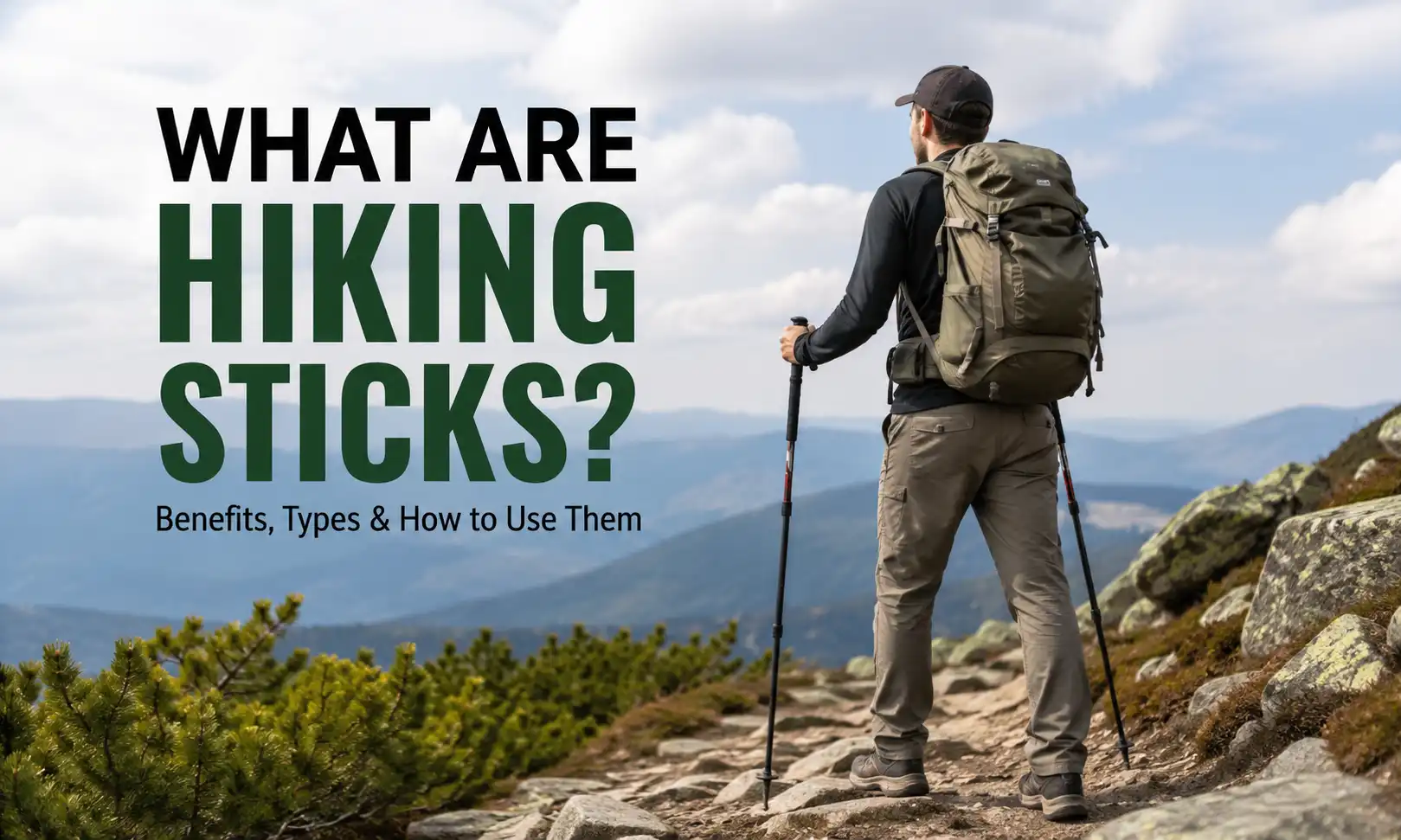
Many hikers wonder about hiking sticks, or trekking poles, and what exactly they do besides adding something extra to carry. These tools are designed to significantly enhance your stability and reduce the physical strain on your body during a hike, making them valuable companions on various terrains. Research indicates that well-designed poles can redistribute up to 20% of your body weight, lessening the impact on your joints.
The decision to use them often comes down to the type of hiking you do and how your body feels on the trail. If you’ve ever experienced knee pain after a descent or felt unsteady on loose ground, understanding what hiking sticks are for can be a real game-changer for your outdoor adventures. This guide will help you figure out if they’re the right addition to your gear.
When Do Hiking Sticks Actually Help? (It Depends!)
If you’re on the fence about whether hiking sticks are worth the extra space in your pack, it really boils down to the conditions you’ll be facing. For some trails and some hikers, they’re an absolute necessity; for others, they might just be a bit of clutter. Our research shows that by understanding a few key variables, you can make a solid decision about whether your next hike calls for poles.
Your Trail Situation: The Key to Using Sticks
The effectiveness of hiking sticks hinges heavily on your environment. For example, if you’re planning a hike on a well-maintained, flat gravel path, the need for extra stability is minimal. However, manufacturer specifications for most trekking poles highlight their utility in more challenging scenarios. These poles are engineered with features like carbide tips designed to grip varied surfaces, which become crucial when the ground is uneven.
When looking at trail conditions, consider the following:
- Terrain Type: Are you on smooth, packed dirt, or are there rocks, roots, and loose gravel?
- Incline/Decline: How steep are the hills you’ll be ascending and descending?
- Weather Conditions: Is the trail likely to be wet, icy, or muddy?
Are Your Knees Talking? (Uh Oh, Signs You Need Support)
For many, the answer to “what are hiking sticks for?” lies in joint preservation. Aggregate user reviews report that hikers who experience knee pain, particularly during descents, find significant relief with poles. This is because poles help absorb some of the repetitive impact. For instance, when descending a steep slope, the force transmitted through your legs to your knees can be substantial.
Using poles can reduce this load, acting as a buffer. According to biomechanical studies, each step downhill can land a force equivalent to three to five times your body weight on your lower extremities. Poles can help dissipate a significant portion of this pressure.
Carrying a Heavy Pack? Sticks Can Be Lifesavers
If you’re embarking on a multi-day trek or carrying a substantial amount of gear, your backpack can weigh you down considerably. This added weight strains your body, especially your ankles and knees, and can throw off your balance. Editorial analysis of hiker feedback indicates that poles distribute this burden more evenly. They provide an additional point of contact with the ground, significantly improving your stability when navigating tricky terrain with a heavy load.
This is particularly helpful as a heavy pack can increase the load on your joints by as much as 100%.
Tackling Tough Trails: Rocks, Roots, and Rivers
When the trail throws unexpected challenges like loose scree, slippery roots, or water crossings, hiking sticks become invaluable. Their primary function in these situations is to enhance your stability and confidence. By planting poles ahead of your steps, you create a more secure base, reducing the risk of slips and falls. For example, when crossing a stream, poles can help you test the depth of the water and maintain balance on submerged rocks or slippery riverbeds.
Having four points of contact versus two can dramatically lower the perceived difficulty and actual risk of these obstacles.
Uphill Power: Digging In for the Climb
While often associated with downhill stability, poles are also surprisingly effective on inclines. When hiking uphill, you can use poles to push off the ground, engaging your arms and upper body to help drive you forward. This action allows you to share the workload between your legs and upper body, which can lead to greater overall efficiency and reduced fatigue in your leg muscles. This technique can be particularly helpful on long, sustained ascents, where conserving leg energy can make a significant difference in your overall endurance.
Some studies suggest that using poles can reduce perceived exertion by as much as 15% on climbs.
The Big Picture: How Hiking Sticks Work Wonders
Beyond specific scenarios, hiking sticks offer a set of fundamental advantages that enhance the overall hiking experience. Think of them not just as aids, but as tools that actively improve your biomechanics on the trail. They work by leveraging principles of physics and human physiology to make your journey smoother and less taxing.
Stability Boost: Your Extra Points of Contact
At their core, hiking sticks provide a form of enhanced stability through increased points of contact with the ground. Where you normally have two feet, poles give you two additional anchors, effectively making your base of support wider and more secure. This is especially critical on uneven surfaces, such as rocky paths or trails with loose gravel. The extra points of contact allow you to react more quickly to shifts in terrain and prevent stumbles, significantly reducing the risk of falls.
Shock Absorption: Saving Your Knees on the Descent
One of the most celebrated benefits of hiking sticks is their ability to absorb shock, particularly during downhill travel. Manufacturer specifications often highlight integrated shock-absorption systems, which can involve internal springs or specially designed pole tips. When you descend, your body takes a significant pounding with each step. Research indicates that poles can absorb up to 25% of this impact energy before it reaches your knees and ankles.
This reduction in force is crucial for preventing long-term joint damage and reducing immediate post-hike soreness. For example, a standard downhill step can transmit hundreds of pounds of force per footstrike to your knees, and poles help mitigate this.
Uphill Power: Digging In for the Climb
While downhill benefits are widely known, poles are also surprisingly effective on inclines. When hiking uphill, you can use poles to push off the ground, engaging your arms and upper body to help drive you forward. This action allows you to share the workload between your legs and upper body, which can lead to greater overall efficiency and reduced fatigue in your leg muscles. This technique can be particularly helpful on long, sustained ascents, where conserving leg energy can make a significant difference in your overall endurance.
Testing the Trail: A Quick Check Ahead
Before you commit your full weight to a step, hiking sticks can act as your advance scouts. By tapping your poles ahead of you, you can quickly gauge the stability of the ground, check for hidden obstacles like small holes or loose rocks, and even assess the depth of water you might need to cross. This proactive use of your poles adds a layer of safety and foresight to your hiking, preventing you from stepping into an unexpected hazard.
Who Should Make Hiking Sticks Their New Best Friend?
The question of “what are hiking sticks for” isn’t just about their function, but about who benefits most from that function. While many hikers can find advantages, certain groups will experience a more profound positive impact from incorporating poles into their gear. Think of this section as a personal checklist to see if you fall into one of these highly compatible categories.
For Those with Aching Joints: Goodbye, Knee Pain!
If your knees often feel the strain, especially after descending a trail, hiking sticks are a highly recommended piece of equipment. They act as an extension of your body, helping to absorb the jarring impact that normally goes directly into your knee joints. This is a critical benefit, as repeated high impact can lead to chronic pain and injury. Research indicates that poles can significantly reduce the peak forces experienced by the knees during downhill travel, making every step feel less punishing.
If you’ve felt that familiar ache creeping in on the way down, poles might be the solution you’ve been looking for.
Tackling Tough Trails: Rocks, Roots, and Rivers
When the trail becomes less of a clear path and more of an obstacle course, hiking sticks shine. Their ability to provide extra points of contact dramatically increases your stability and confidence. Navigating over loose rocks, through tangled roots, or across slippery stream beds becomes far less precarious. By planting poles ahead of your foot, you create a more secure platform, testing the ground before you fully commit your weight.
This proactive approach helps prevent stumbles and falls that can easily happen on challenging terrain.
Carrying a Heavy Pack? Sticks Can Be Lifesavers
For overnight trips or when carrying essential gear for a long day, your backpack can add significant weight. This extra load puts considerable stress on your entire body, particularly your spine, hips, and knees, and can compromise your balance. Editorial analysis from outdoor adventure communities consistently reports that hiking poles help redistribute this weight. They offer an additional anchor point, allowing you to better manage your center of gravity and take some of the strain off your lower body.
This can make traversing long distances with a heavy pack feel much more manageable and less exhausting.
Long-Haul Hikers: Going the Extra Mile (Comfortably)
If you’re someone who loves extended hikes, be it a thru-hike or simply covering many miles on a single outing, the cumulative impact on your body can be considerable. Hiking sticks help mitigate this fatigue and stress over time. By engaging your upper body and reducing the load on your legs and joints with each step, they allow you to maintain a more consistent pace and cover more ground with less discomfort. This can be the difference between finishing your hike strong and feeling completely depleted.
As of 2026, many long-distance hikers consider poles an essential piece of gear for endurance and joint health.
What Is Thru Hiking? And How Do Poles Fit In?
Thru-hiking, which involves completing an entire long-distance trail in one continuous journey, presents unique challenges for the body. Trails like the Appalachian Trail or the Pacific Crest Trail can span thousands of miles, requiring months of sustained effort. Hiking sticks are exceptionally useful in this context because they help hikers manage the relentless repetitive stress inherent in such endeavors. They aid in maintaining balance over highly varied terrain, reduce impact on joints during countless descents, and allow for a more efficient energy expenditure by engaging the upper body.
This means thru-hikers can often travel further with less strain, contributing to their ability to complete such monumental journeys.
When You Might Want to Leave Them Behind
While hiking sticks offer many benefits, they aren’t always the ideal choice for every situation or every type of hike. Understanding when not to use them is just as important as knowing when they’re beneficial. Overly relying on poles when they aren’t needed can sometimes be more of a hindrance than a help, or simply unnecessary extra gear to manage.
Easy Trails: When Poles Feel Like Too Much
If you’re out for a leisurely stroll on a well-maintained, flat trail, think a paved park path or a smooth, packed dirt fire road, hiking sticks might feel like overkill. In these scenarios, the terrain doesn’t present significant stability challenges or downhill impact. Using poles could add unnecessary complexity to your walk. They might get in your way, snag on low-hanging branches, or simply feel like an extra item to keep track of without providing a noticeable advantage.
For such forgiving environments, you might find it simpler and just as effective to walk without them.
Hands-On Scrambling: When You Need Both Hands Free
Some hikes involve sections where you need to use both hands for balance or to navigate technical rock scrambles. This might include climbing over large boulders, using chains for assistance, or maneuvering through very tight spaces. In these moments, carrying hiking sticks can be cumbersome and even dangerous. You’d need to stop, collapse your poles, and stow them, which can disrupt your rhythm and potentially cause you to drop your gear.
If your planned route involves significant portions requiring both hands, it’s generally best to leave the poles behind.
Common Mistakes Hikers Make with Their Sticks
Even when you decide to use hiking sticks, there are ways to use them incorrectly that can diminish their benefits or even cause new problems. Learning these common errors can help you avoid them and maximize the advantages poles offer. It’s not just about having them; it’s about using them effectively for your safety and comfort on the trail.
Pole Placement Problems: Where NOT to Plant Them
A frequent mistake is planting poles too close to your body or directly in your path, which can create tripping hazards. When hiking on gentle terrain, you typically want to plant poles slightly forward and to the sides of your body, creating a stable tripod effect with your feet. On steep descents, the pole placement might shift slightly back to help you control your momentum. Aggressively jamming poles into soft ground can also cause them to get stuck or break, especially if they have thin tips.
Incorrect Length: Too High? Too Low?
Getting the length of your hiking sticks right is crucial for maximizing their benefit and avoiding strain on your wrists and shoulders. A common guideline for downhill hiking is to adjust the poles so your elbow is bent at about a 90-degree angle when the tip is on the ground. For uphill hiking, you might shorten them slightly. Manufacturer specifications often provide detailed sizing charts.
Using poles that are too long can cause your shoulders to hunch, leading to fatigue, while poles that are too short can put excessive strain on your wrists and lead to less effective propulsion.
Over-Reliance: Letting Poles Do All the Work
While poles are designed to help, relying on them too heavily can lead to neglecting your natural balance and core engagement. Your body is meant to adapt to terrain, and poles are a supplement, not a replacement, for that. Hikers sometimes lean too hard on their poles, almost letting them bear their full weight, which can lead to early arm fatigue or a false sense of security that results in a misstep. It’s important to maintain active engagement with your surroundings and use your poles as a supportive tool rather than a crutch.
Making the Decision: Are Sticks for You?
Deciding whether hiking sticks are a worthwhile addition to your gear is a personal choice often guided by your typical hiking style and physical condition. You’ve learned about the broad benefits, the specific scenarios where they excel, and even when they might be less useful. Now, it’s about consolidating that knowledge to make a clear, actionable decision for your own adventures.
The “Should I Get Them?” Checklist
To help you decide, consider this quick evaluation. If you answer “yes” to most of these questions, then hiking sticks are likely a good investment.
- Do you frequently hike on trails with significant elevation changes (steep ascents or descents)?
- Do you experience any knee, hip, or ankle discomfort, especially after hiking?
- Do you often carry a backpack weighing more than 15 pounds on your hikes?
- Do you hike on frequently uneven terrain with rocks, roots, or loose surfaces?
- Are you interested in reducing overall physical fatigue on longer hikes?
- Do you want to improve your balance and reduce the risk of slips and falls?
If these points resonate with you, exploring different types of trekking poles would be a logical next step.
Getting the Most Out of Your Sticks: Pro Tips for the Trail
Once you’ve decided that hiking sticks are for you, learning to use them effectively will unlock their full potential. It’s more than just carrying them; it’s about integrating them smoothly into your stride and technique. Think of it like learning to use any new tool, the more you practice, the better you become. Many resources, like those found on how to use hiking poles, offer detailed guidance.
Adjusting for Different Terrains
The optimal length for your hiking sticks isn’t static. When moving downhill, you generally want your poles slightly longer so your elbows are at roughly a 90-degree angle when the tips are on the ground. This position helps your arms absorb some of the impact. For uphill hiking, you’ll typically want to shorten the poles.
This allows for a more effective push-off with your arms, helping to propel you forward and balance the effort between your upper and lower body. Manufacturer instructions usually detail how to adjust their specific locking mechanisms.
Proper Pole Planting Technique
Planting your poles correctly is key to getting the intended benefits. On balanced terrain, you’ll usually plant the pole opposite your stepping foot, creating a stable tripod. For ascents, you’ll push off with both poles to assist your climb. On descents, you might use them more for balance and shock absorption, planting them to control your momentum.
Avoid planting directly in front of your feet, which can cause you to trip, and be mindful of planting angles to avoid embedding them too deeply or causing them to snag.
Essential Features to Look For
When you’re in the market for hiking sticks, you’ll notice a variety of features. Understanding what these mean can help you choose a pair that best suits your needs and hiking style. It’s not just about brand names; it’s about the practical elements that impact performance and durability.
Adjustable vs. Fixed Length
The most common types are adjustable and fixed-length poles. Adjustable poles offer the significant advantage of being able to change their length, which is ideal for varying terrain and for sharing between hikers of different heights. They typically use twist-lock or flick-lock mechanisms to secure their length. Fixed-length poles are often lighter and potentially more durable due to fewer moving parts, but you’ll need to purchase them in a length that precisely matches your needs.
Grip Comfort and Material
The grip is where your hands connect with the poles, so comfort is paramount. Materials like cork conform to your hands over time and wick away sweat, making them excellent for warmer conditions. Foam grips are soft, absorbent, and provide good cushioning, while rubber grips offer excellent traction but can become slippery when very sweaty or wet. Consider how long you’ll be holding the poles and what kind of weather you typically hike in when choosing a grip material.
Locking Mechanisms: Twist vs. Flick
Adjustable poles rely on locking mechanisms to maintain their length. Twist-lock systems require you to rotate sections of the pole until they tighten, while flick-lock mechanisms use a lever that snaps shut to secure the sections. Both have pros and cons. Twist-locks can sometimes slip if not tightened properly or if subjected to extreme temperature changes.
Flick-locks are generally considered easier and quicker to adjust, especially when wearing gloves, and tend to be more reliable in various weather conditions.
Quick Answer: Do You Need Hiking Sticks?
Do you need hiking sticks? For many hikers, especially those who tackle varied terrain, carry moderate to heavy loads, or experience joint discomfort, the answer is a resounding yes. They offer tangible benefits in stability, shock absorption, and reduced fatigue. If your hikes are mostly on flat, smooth paths and you don’t carry much weight, they might be optional.
However, for most outdoor enthusiasts seeking to enhance their comfort and safety on the trail, poles are a highly recommended addition to their gear.
