

I was eight miles into a 14-mile out-and-back on the Appalachian Trail in northern Virginia when my legs stopped working the way legs are supposed to work. Not cramping. Not tired. Just… heavy. Like someone had filled my quads with wet sand overnight. My brain went foggy about a mile later. I had two granola bars left, one water bottle, and six miles of trail between me and my car.
That was the day I learned that “eat when you’re hungry” is a terrible hiking nutrition strategy.
I’ve been hiking for over a decade now — day hikes, multi-day backpacking trips, desert crossings in July heat, winter ridge walks in the Cascades. I’ve made almost every fueling mistake a person can make. And I’ve spent a lot of time since that Virginia hike figuring out the actual numbers behind hiking calorie burn and intake.
By the end of this article, you’ll know how to estimate your calorie burn per mile, use a simple formula to plan how much you need to eat, and build a real fueling plan for any hike — from a quick 5-miler to a 5-day backpacking loop.
Quick answer: A 150-lb hiker burns roughly 300–400 calories per hour at a moderate pace on flat terrain. Add elevation, pack weight, or summer heat, and that number climbs fast. Most hikers need 200–300 calories per hour at minimum to keep energy levels stable on trail.
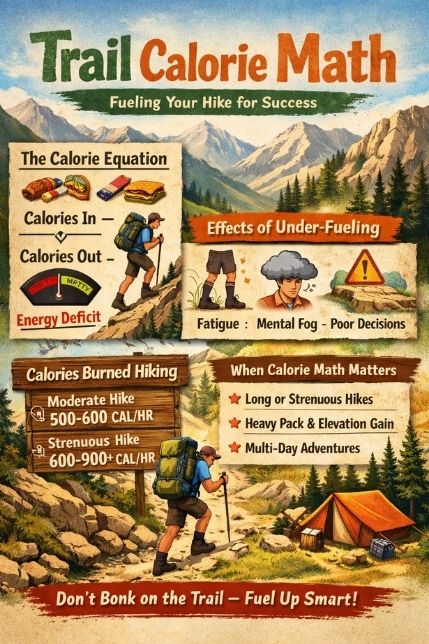
Why Calorie Math Actually Matters on the Trail?
Under-fueling while hiking leads to glycogen depletion, muscle fatigue, and poor judgment — especially dangerous on technical terrain or remote trails. “Eat when you’re hungry” sounds reasonable at a desk. On a long hike, your hunger cues often lag two to three hours behind your actual energy needs.
What Happens When You Under-Fuel on a Hike
Your body runs on glucose. When your muscles burn through their glycogen stores faster than you’re replacing them, you bonk — also called “hitting the wall.” Your legs feel like they weigh twice as much. Your thinking slows. Your mood goes dark. On an easy trail near a parking lot, that’s just miserable. On a remote ridgeline or a trail with a technical descent, it becomes a safety problem.
Poor fueling also messes with your thermoregulation. If your body is already fighting to stay warm or cool, and you’re not giving it enough fuel to work with, both battles get harder at once. I’ve seen strong hikers turn into a liability on trail simply because they didn’t eat enough in the first four hours.
Why Hiking Burns More Calories Than Most People Think
Most people compare hiking to walking. That’s not quite right. Walking on a flat sidewalk has a MET (Metabolic Equivalent of Task) value of about 3.5. Moderate trail hiking sits between 5.3 and 6.0. Add a heavy pack and a climb, and you can push that to 7.0 or higher. That’s closer to a jog than a walk, in terms of energy cost. People show up for a “casual” 10-mile hike having eaten a normal breakfast, and they’re surprised when they fall apart by mile six.
Energy Balance Basics for Hikers
Energy balance is simple: calories in versus calories out. On trail, the gap between those two numbers gets wide fast — much faster than in daily life. A normal sedentary day might have you burning 2,000 calories total. A hard day on trail can push that to 4,500. If you only eat your usual three meals, you’re running a massive deficit before the first switchback. That deficit doesn’t just slow you down — it affects your decision-making and increases your injury risk.
Who Needs to Track Hiking Calories Most Carefully
If you’re doing short, easy hikes under five miles, you probably don’t need a spreadsheet. But if you’re tackling full-day hikes of 10 miles or more, going into the backcountry overnight, dealing with significant elevation gain, or trying to maintain performance across multiple trail days — the math matters. Hikers trying to lose weight on trail need to be especially careful. A calorie deficit is fine in theory, but too large a deficit on a long hike leads to bonking, which can be dangerous.
How Many Calories Do You Burn Hiking Per Mile?
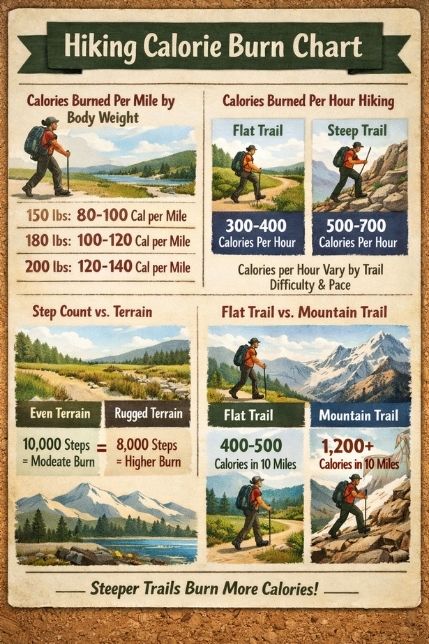
On flat terrain, most hikers burn 80–130 calories per mile depending on body weight and pace. On steep or rugged terrain, that figure can reach 150–200+ calories per mile.
Those numbers shift a lot based on who you are and where you’re hiking. Let me break it down.
Average Calories Burned Per Mile Hiking by Body Weight
Body weight is the biggest single factor in calorie burn per mile. A 150-lb hiker on a flat, moderate trail burns roughly 80–100 calories per mile at a steady pace. A 180-lb hiker burns closer to 100–120. At 200 lbs or more, you’re looking at 120–140 calories per mile on similar terrain. These numbers assume flat ground, no pack weight beyond day gear, and a comfortable walking pace. Every one of those variables pushes the number up.
Calories Burned Per Hour Hiking vs. Per Mile
Here’s where people get confused. Calories per hour and calories per mile aren’t the same thing — and they don’t move together in a straight line. A slower hiker on steep terrain may burn more calories per hour than a fast hiker on flat ground, even if they cover less distance. Per-mile estimates are useful for planning food quantities. Per-hour estimates are more useful for understanding your energy output on a specific type of trail.
How Step Count Relates to Calorie Burn on Trail
GPS watches and fitness trackers estimate calories partly through step count. That works fine on a treadmill. On an uneven trail, it gets messier. Rocky terrain, scrambling sections, and steep downhills involve a lot of muscle engagement that doesn’t show up clearly in step count. My Garmin tends to undercount calorie burn on technical trails by a meaningful margin — more on that in the tracking section.
Flat Trail vs Mountain Trail Calorie Burn
I tested this back-to-back one year. I did a 10-mile flat canal path near my home in Maryland, then a 10-mile Rocky Mountain day hike in Colorado with 2,500 feet of elevation gain. Same distance. Same pack. My Garmin said the Colorado hike burned nearly 800 more calories. The actual difference was probably even larger, because watches tend to underread on technical terrain. If you’re planning food for a mountain trail using flat-trail estimates, you’ll run short every time.
The Hiking Calorie Formula Explained
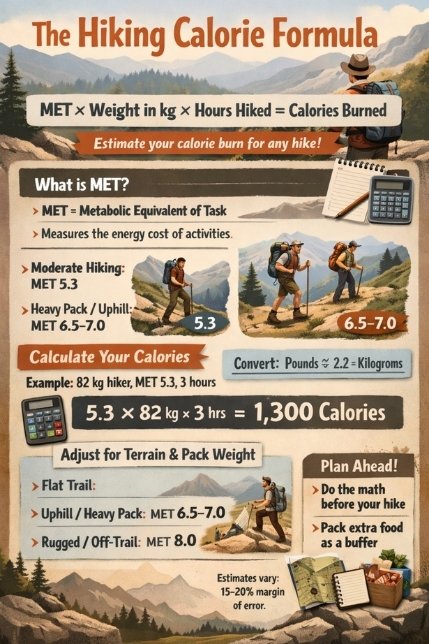
To estimate hiking calories burned, use this formula: MET × your weight in kg × hours hiked. A 180-lb (82 kg) hiker doing moderate trail hiking (MET 5.3) for 3 hours burns approximately 1,300 calories.
No app required. You can do this math the night before a hike with a piece of paper and a basic calculator.
What MET Values Are and Why Hikers Should Know Them
MET stands for Metabolic Equivalent of Task. It’s a way of measuring how much energy an activity costs relative to sitting still. Sitting quietly has a MET of 1. Moderate hiking has a MET of around 5.3. Hiking uphill with a heavy pack can push MET to 6.5 or 7.0. The Compendium of Physical Activities — a research database used by exercise scientists — is the gold standard for these values. Knowing your hike’s likely MET gives you a much better calorie estimate than guessing.
The MET Hiking Calorie Formula Step by Step
The formula is: Calories per hour = MET × body weight in kilograms
To get total calories for a hike, multiply that result by your time on trail in hours.
Here’s a worked example. Say you weigh 180 lbs (82 kg) and you’re doing a moderate trail hike with rolling terrain — call that a MET of 5.3. Your hourly burn is 5.3 × 82 = 435 calories per hour. On a 4-hour hike, that’s 1,740 calories from hiking alone. Add your basal metabolic rate for those hours, and your total energy need for that window goes up further.
To convert pounds to kilograms, divide by 2.2.
Adjusting MET Values for Terrain and Pack Weight
MET values aren’t fixed. You adjust them based on what the hike actually involves. Flat trail hiking is around 5.3. Add significant elevation gain and bump it to 6.0–6.5. Add a 30+ lb backpacking pack and push to 7.0 or higher. Off-trail scrambling on loose rock can hit 8.0. This isn’t guesswork — these adjustments are backed by published research on energy expenditure in outdoor activity. When I plan food for a backcountry trip with heavy days, I use 6.5–7.0 as my MET baseline and I’ve found it to be reliable.
Free Hiking Calorie Calculators Worth Using
If you’d rather not do the math by hand, a few tools are worth using. AllTrails has a rough calorie estimate built into its app. Garmin and Coros GPS watches generate calorie data from heart rate and activity type, though their accuracy varies. For backcountry trips where I have no phone signal, I always do the manual calculation before I leave — it only takes five minutes and it shapes how much food I pack.
How Accurate Are Hiking Calorie Estimates?
Honest answer: none of them are perfect. The MET formula has a typical margin of error around 15–20% depending on individual fitness level and terrain specifics. GPS watches can be off by 20–30% in either direction. Apps that don’t use your heart rate are more guess than science. I use the MET formula as a planning baseline and I always pack a small buffer — an extra 200–300 calories per day beyond my estimate. That buffer has saved me on more than a few long days.
On a 4-day Sierra Nevada permit trip last summer, I had zero cell signal from day one. I’d done my MET math the night before at the trailhead and built my food bag around it. By day three I was grateful I had. The terrain was harder than the map suggested, and my hand-calculated estimate kept me from running short.
What Changes Your Calorie Burn on a Hike?
Elevation gain, high heat, cold temperatures, and a heavy pack can each add 10–30% to your baseline calorie burn. On a demanding mountain day, a 180-lb hiker may burn 600–900+ calories per hour.
That’s a big range. Here’s what actually drives the number up or down.
How Elevation Gain Multiplies Calorie Expenditure
Research consistently shows that each 1,000 feet of elevation gain adds a significant chunk to your calorie burn — roughly 100–150 extra calories per 1,000 feet for an average adult, depending on pace and body weight. A trail that looks moderate on paper becomes a very different proposition when it involves 4,000 feet of total gain. I’ve done plenty of peak-bagging days in the Colorado Rockies where the calorie math was completely different from a flat trail of the same mileage.
Body Weight and Pack Weight — the Double Load Effect
Every extra pound you carry — whether it’s body weight or pack weight — costs you more energy per mile. A 30-lb backpacking pack on a 180-lb hiker adds roughly 16% more load to their frame. That compounds over miles. Heavy pack + heavy body = high calorie burn. This is part of why experienced backpackers obsess over pack weight. Lighter packs mean you can go longer on less fuel, or finish stronger with the same food supply.
Hiking in Heat and Calorie Burn
Your body burns extra calories regulating its core temperature in the heat. Sweating is a metabolic process. Pumping blood to your skin for cooling takes energy. On a hot summer day in the Utah desert or the Grand Canyon’s inner gorge, you might burn 10–20% more calories than you would on the same trail in cool weather — while simultaneously dealing with greater dehydration risk. I noticed this on a July trip along the Colorado River Trail: I was eating the same snacks I’d packed for a fall hike of similar distance and I was running low by mid-afternoon.
Cold Weather Hiking Calorie Needs
Cold weather is the other end of the same problem. Your body burns extra calories generating heat when temperatures drop. The amount varies with how well you’re layering and how cold it actually is, but winter hiking in the Cascades or the Northeast routinely demands 10–30% more calorie intake than warm-weather hiking at the same intensity. Hot meals and calorie-dense snacks matter more on cold days, not just for morale but for real energy reasons.
Dehydration and Its Sneaky Effect on Perceived Exertion
Even mild dehydration — around 2% of body weight — measurably increases how hard exercise feels. Your heart rate goes up. Your muscles work less efficiently. And your hunger cues can go haywire; sometimes dehydration masks as hunger, sometimes it suppresses it entirely. I hiked the same trail in July and then again in October with the same pack weight and the same food. In October I felt strong and well-fed at every break. In July I felt hungry an hour earlier and drained by early afternoon — the difference was mostly heat-driven dehydration, not a change in my food.
How Many Calories Should You Eat Before, During, and After a Hike?
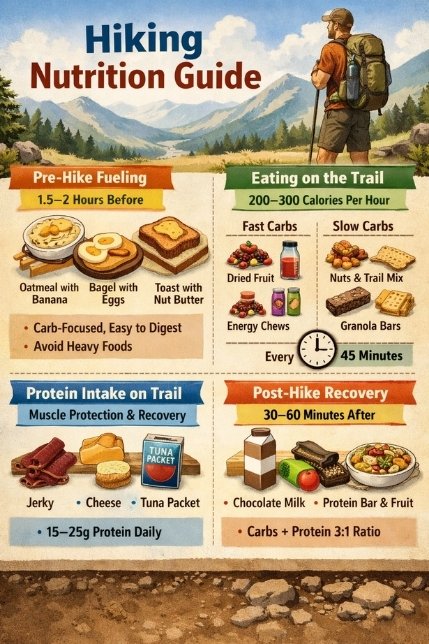
Eat 200–300 calories per hour while hiking, prioritizing carbohydrates. A mix of fast-acting carbs and slower-releasing sources keeps energy steadier than eating all at once.
Timing matters almost as much as quantity. Here’s how I structure it.
Pre-Hike Fueling — What to Eat 1–2 Hours Before You Start
Your pre-hike meal should be carbohydrate-forward and easy to digest. Oatmeal with a banana, toast with nut butter, or a bagel with eggs all work well. Aim for 400–600 calories depending on hike length. Eat 1.5–2 hours before you start — close enough that you’re not starting on empty, far enough out that you’re not hiking with a full stomach. Avoid heavy, fatty foods right before a long effort. Your gut doesn’t prioritize digestion when your legs are working hard.
On-Trail Eating — Calorie Targets Per Hour While Hiking
The standard advice from sports nutrition research is 30–60 grams of carbohydrate per hour for sustained effort — that’s roughly 120–240 calories from carbs alone. Add some fat and protein from trail mix or a bar and you’re in that 200–300 calories per hour range. Don’t wait until you feel hungry. By the time hunger hits, your blood sugar has already dipped. I set a timer for 45 minutes on long hikes. When it goes off, I eat something — whether I feel like it or not.
On a 20-mile ridge hike in the White Mountains of New Hampshire, I switched from random snacking to eating on that 45-minute schedule. The last six miles felt dramatically better than any comparable long day I’d done before. My legs were still tired, but my brain stayed clear and I didn’t bonk.
Carbohydrate Intake on Trail — the Primary Fuel Source
Carbohydrates are your muscles’ preferred fuel during sustained aerobic exercise. Fat burns too — especially at lower intensities — but carbs are what keep you moving efficiently at hiking pace for hours at a time. On trail, fast-acting carbs (dried fruit, gummy chews, energy gels) give you a quick lift. Slower-releasing carbs (oats, whole grain crackers, tortillas) keep things stable. I mix both — some quick-release for mid-climb and some slower fuel for steady cruising.
Protein Intake Hiking — Recovery and Muscle Protection
Protein isn’t your main fuel while hiking, but it matters for two reasons. First, it slows the breakdown of muscle tissue during long efforts — especially important on multi-day trips. Second, it starts the recovery process. Aim for 15–25 grams of protein in your post-hike meal within about 30–60 minutes of finishing. On trail, cheese, jerky, and nuts provide portable protein throughout the day. I’ll often add a packet of tuna or a small hard-boiled egg in the first part of a day hike when I know I’ll be covering serious miles.
Post-Hike Recovery Nutrition
Your body is most ready to restock its glycogen stores in the first 30–60 minutes after finishing a hard hike. A snack or meal with a 3:1 ratio of carbohydrates to protein is a solid target. Chocolate milk actually works well for this — it has the right ratio and is easy to keep in a cooler at the trailhead. I keep a protein bar and a piece of fruit in my car for when I get off trail. After a full-day hike, my first real meal is usually rice or pasta with a protein source — nothing fancy, just enough to start the rebuild.
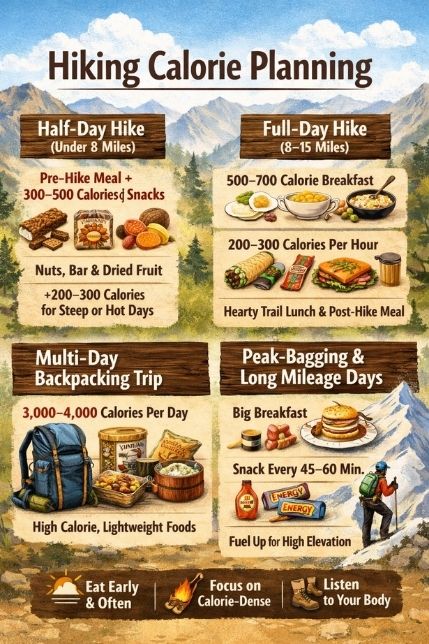
Calorie Planning by Hike Length
Backpackers typically need 2,500–4,500 calories per day depending on pack weight, terrain, and body size. Day hikers on a full-day trail may need 2,000–3,000 calories total for the day.
Here’s how I plan it based on hike type.
Calorie Needs for a Half-Day Hike (Under 8 Miles)
For a half-day hike on moderate terrain, most people don’t need a complex meal plan. A solid pre-hike meal plus 300–500 calories of trail snacks usually covers it. Think a handful of nuts, a bar, and some dried fruit. If the terrain is steep or it’s a hot day, add another 200–300 calories to that. I treat these hikes like extended gym sessions rather than full nutrition events — a little extra fuel, but no need to overthink it.
Calorie Needs for a Full-Day Hike (8–15 Miles)
A full-day hike — especially one with meaningful elevation — is a real fueling event. I aim for 500–700 calories before I start, then 200–300 calories every hour on trail, plus a post-hike recovery meal. Total day intake for a 10-hour hike day can hit 3,000–3,500 calories depending on body size. I usually pack a substantial lunch (wrap with protein, cheese, some crackers) in addition to snacks spread through the day. Don’t rely on dinner to make up for a deficit built up over 10 hours of moving.
Calorie Needs for a Multi-Day Backpacking Trip
Multi-day backpacking is where calorie math really matters. Most backpackers need between 2,500 and 4,500 calories per day, and many still end trips having lost weight — because even well-planned food often falls short of actual expenditure. Food weight becomes a constraint, which is why calorie density matters so much (more on that in the next section). I plan for a minimum of 3,000 calories per day on any trip with significant mileage and elevation, and I go closer to 3,500–4,000 for demanding mountain terrain.
On a 4-day loop in Wyoming’s Wind River Range a few years back, I packed what I thought was plenty — about 2,800 calories per day. By day three, I was digging into my emergency food stash. The altitude was around 10,000–11,500 feet, the passes were steep, and I was moving a heavy-ish pack. I came home with a better understanding of how much I actually burn in the mountains. Now I always add a 10–15% buffer on top of my calorie estimate for any backcountry trip.
Calorie Planning for Peak-Bagging and High-Mileage Days
On a big summit day — long approach, significant elevation gain, technical terrain — I front-load my calorie intake. A large breakfast, an early first snack, and consistent eating every 45–60 minutes from the start. Altitude suppresses appetite in a lot of people, including me. Once you’re above 11,000 feet, you may not feel hungry even when your body desperately needs fuel. Eating by the clock is even more critical on high-altitude days than on lower-elevation hikes.
Choosing High-Calorie Density Foods for the Trail
Aim for trail foods with at least 100 calories per ounce. Nuts, nut butters, hard cheese, and olive oil are among the most calorie-dense options that also require no cooking.
Calorie density is what separates good trail food from weight that doesn’t earn its place in your pack.
What Calorie Density Means and Why It Matters for Hikers
Calorie density is simply how many calories a food delivers per unit of weight — typically measured as calories per ounce (cal/oz). For a short day hike, this doesn’t matter much. For a multi-day backpacking trip where every ounce of pack weight affects your knees and your pace, it matters enormously. A food with 75 cal/oz means you’re carrying more weight per calorie than one with 150 cal/oz. Over four days of food, that difference can add up to a pound or two in your pack.
Best High-Calorie Density Trail Foods
Almonds and cashews come in at around 160–170 calories per ounce. Peanut butter packets are around 160–180 cal/oz. Hard cheese (parmesan, aged cheddar) runs 100–120 cal/oz and travels well without refrigeration for a day or two. Beef jerky is lower-density at around 70–80 cal/oz but provides protein. Dark chocolate is about 150–160 cal/oz. Freeze-dried meals average 100–120 cal/oz. And olive oil — pure fat at about 240 calories per ounce — is the single highest-density food you can put in a pack.
Foods That Feel Filling but Don’t Deliver Trail Energy
Fresh apples, oranges, and veggie sticks are mostly water. They feel substantial but deliver 10–20 calories per ounce. Low-fat granola bars often come in around 80–90 cal/oz with a lot of sugar and not much staying power. Rice cakes — light, large, and satisfying-seeming — are around 110 cal/oz but burn through fast. None of these are bad foods in daily life. On a long trail day where you’re trying to fuel real energy output, they’re dead weight if they’re your primary snack strategy.
Balancing Calorie Density with Digestion on Trail
Ultra-high-fat foods digest slowly. That’s usually fine during steady-pace hiking, but if you’re pushing hard on a climb, a stomach full of dense fat can feel terrible. I mix dense and lighter foods through the day — a few nuts and some crackers early on, a chocolate square mid-climb, a peanut butter wrap at lunch. The best trail food plan layers fast-carb options for high-intensity moments with slower-releasing, fat-heavy snacks for rest periods and steady cruising.
I added a small 4 oz bottle of olive oil to my kit on a Cascades backpacking trip on a recommendation from a friend. I was skeptical. I drizzled it on everything — ramen, rice, instant mashed potatoes. By the end of the trip, that small bottle had added nearly 1,000 calories to my overall intake with almost no extra pack weight. I’ve carried it on every backpacking trip since.
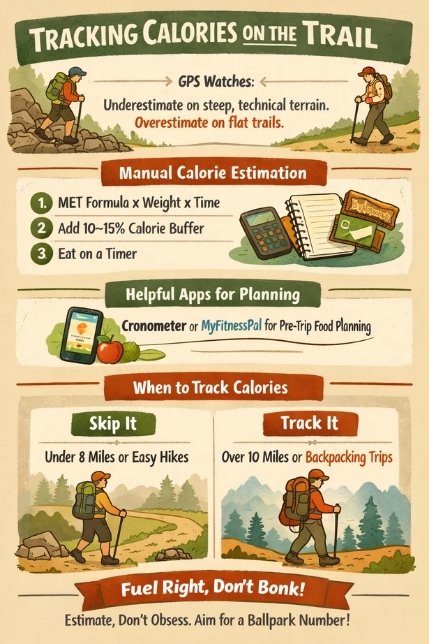
Tracking Calories on a Hike
GPS watches underestimate calorie burn on technical terrain and overestimate on flat paths. For better accuracy, combine heart rate data from your watch with a manual MET estimate adjusted for your actual hike conditions.
Here’s what actually works — and what’s not worth the effort.
Using GPS Watches to Track Calorie Burn on Trail
Garmin, Coros, and Apple Watch all use a combination of heart rate, movement, and activity type to estimate calorie burn. They’re reasonably accurate on well-defined paced efforts. On technical trail with lots of scrambling, side-hilling, and irregular terrain, they tend to miss the mark. Garmin watches in particular seem to undercount calorie burn when terrain is uneven and pace is variable. I’ve tested my watch against manual MET calculations on the same hike multiple times and the watch is typically 15–25% low on steep, technical days.
Manual Calorie Tracking for Hikers Who Prefer Low-Tech
My preferred method for backcountry trips is simple: run the MET formula the night before, pack that many calories plus a 10–15% buffer, and eat on a timer. No app required on trail. I’ve used this method reliably from the Sierra Nevada to the Appalachians. The math takes about five minutes with a phone calculator. Once you’ve done it a few times, it becomes second nature.
Apps Worth Using for Hiking Nutrition Tracking
For pre-trip planning, Cronometer is my favorite. You can build out your food list, check calorie totals, and verify your cal/oz ratios before you buy anything. MyFitnessPal works too, though its outdoor activity database is less precise. Neither of these is something I use on trail — they’re planning tools, not real-time ones. A waterproof notepad and a pencil does more for me on trail than any app once I’ve left the car.
Should You Track Calories on Every Hike?
For hikes under 8 miles on moderate terrain, no — it’s not worth the mental energy. For anything over 10 miles, or any backpacking trip, yes — a rough estimate before you go helps you pack the right amount of food and prevents bonking. I don’t track calories obsessively, and I’d encourage you not to either. The goal is to have a reliable enough estimate that you’re fueling well on trail, not to hit a perfect number to the calorie. A ballpark built on solid math is all you need.
Frequently Asked Questions
How Many Calories Do You Burn Hiking Per Mile?
Most hikers burn 80–130 calories per mile on flat terrain. Body weight is the biggest factor — heavier hikers burn more. Add elevation gain, a heavy pack, or rough terrain, and that figure rises to 150–200+ calories per mile. Use body weight and terrain type together to get a more accurate estimate.
How Many Calories Should I Eat on a Long Hike?
On a full-day hike of 8–15 miles, most hikers need 2,500–3,500 calories for the whole day. Eat a solid pre-hike meal, then aim for 200–300 calories every hour on trail. Don’t rely on hunger to tell you when to eat — it lags too far behind your actual energy needs.
Does Hiking Uphill Burn Significantly More Calories?
Yes — significantly. Each 1,000 feet of elevation gain can add 100–150 extra calories to your burn, on top of the base cost of moving forward. A hike with 4,000 feet of gain burns hundreds of calories more than a flat hike of the same distance. Steep terrain also raises your MET value, which multiplies your per-hour calorie output.
What Is the Best Food to Eat While Hiking for Energy?
Fast-digesting carbohydrates work best for immediate energy on trail — dried fruit, energy chews, gels, and crackers. For longer-lasting fuel, combine those with slower sources like nut butter, cheese, or a tortilla wrap. Avoid high-fat foods right before or during intense climbing sections, as they digest slowly and can cause stomach discomfort at high effort.
How Do I Calculate My Calorie Burn on a Hike Without an App?
Use the MET formula: calories per hour = MET × body weight in kg. For moderate hiking, use a MET of 5.3. For steep terrain or a heavy pack, use 6.5–7.0. Multiply your hourly burn by your expected hours on trail. Convert your weight from pounds to kg by dividing by 2.2. The whole calculation takes under two minutes.
Do You Burn More Calories Hiking in the Heat or the Cold?
Both conditions increase calorie burn, but in different ways. Heat forces your body to work harder to cool itself — thermoregulation has a real energy cost. Cold weather requires extra calories for heat generation. In extreme conditions on either end, you can see 10–30% increases over a moderate-weather baseline. Plan for higher intake on both hot desert days and cold winter hikes.
How Many Calories Does a Backpacker Need Per Day?
Most backpackers need 2,500–4,500 calories per day, depending on body size, pack weight, terrain, and elevation. Many backpackers still lose weight on multi-day trips even when eating well. Plan for at least 3,000 calories per day on any demanding trip, and go higher for big mountain days. Aim for foods with 100+ calories per ounce to keep your food bag manageable.
Can Hiking Help With Weight Loss If I Eat at a Calorie Deficit?
Yes — hiking burns a significant number of calories, and a modest deficit over time does produce weight loss. The key word is modest. An extreme deficit on a long hike causes bonking, muscle breakdown, and poor decision-making. Aim for a deficit of no more than 300–500 calories per day on active hiking days. Refuel enough to hike safely; let the sustained activity over days and weeks do the work.
Final Thoughts
Calorie math sounds more complicated than it is. Once you’ve run the MET formula a couple of times, it takes five minutes before any hike. You know roughly what you’ll burn. You pack accordingly. You eat on a schedule instead of waiting for hunger that comes too late.
Three things to take away from this article. First, use the MET formula — not a guess, not just hunger — to estimate your burn. Second, plan your intake before you leave, not on trail. Third, timing matters: eating every 45–60 minutes keeps your energy far more stable than eating in big infrequent chunks.
The difference between a strong finish and a miserable last four miles is often just food. I learned that the hard way in Virginia. You don’t have to.
If you found this useful, I’d love to hear how you fuel your hikes — drop a comment below and tell me your go-to trail snack. And if you want to go deeper on what to actually put in your pack, check out my post on the [Best High-Calorie Backpacking Foods for Multi-Day Trips] — it pairs directly with the density section above.
Read More:
→ How many calories does hiking burn
→ Hiking for weight loss tips
→ Best hiking snacks for energy
→ How to train for hiking

Oscar is a passionate hiker and outdoor enthusiast who has explored trails across mountains, forests, and national parks. He created Oscar Hikes to share honest, beginner-friendly advice on hiking gear, trail safety, and outdoor preparation — so every first-timer can hit the trail with confidence. When he’s not hiking, he’s testing gear and writing guides to make your next adventure easier.
6 thoughts on “Hiking Calorie Calculator: How Many Calories Do You Really Need Per Mile?”