

I remember standing shin-deep in a snowmelt creek on the PCT in early May, watching cold water pour right over the collar of my Gore-Tex boots. My feet were soaked in seconds — despite paying a premium for “waterproof.” I also remember a June climb in the Cascades where the rain never showed, but my feet were drenched in sweat by noon anyway. Both times, I was wearing waterproof boots. Both times, I questioned my choice.
I’ve hiked through the Pacific Northwest in November rain that never stops, across the dry slickrock of southern Utah in July heat, and through knee-deep snowpack in Colorado’s Rocky Mountain National Park. I’ve worn waterproof boots, non-waterproof trail runners, and full-grain leather boots that I’ve resoled twice. I know what each one does well — and where each one lets you down.
This is not a gear review. It’s a straight answer to one question: for your trails, your conditions, and your feet — are waterproof hiking boots actually worth it? By the end, you’ll know exactly when to buy waterproof, when to skip it, and what I reach for in each case.
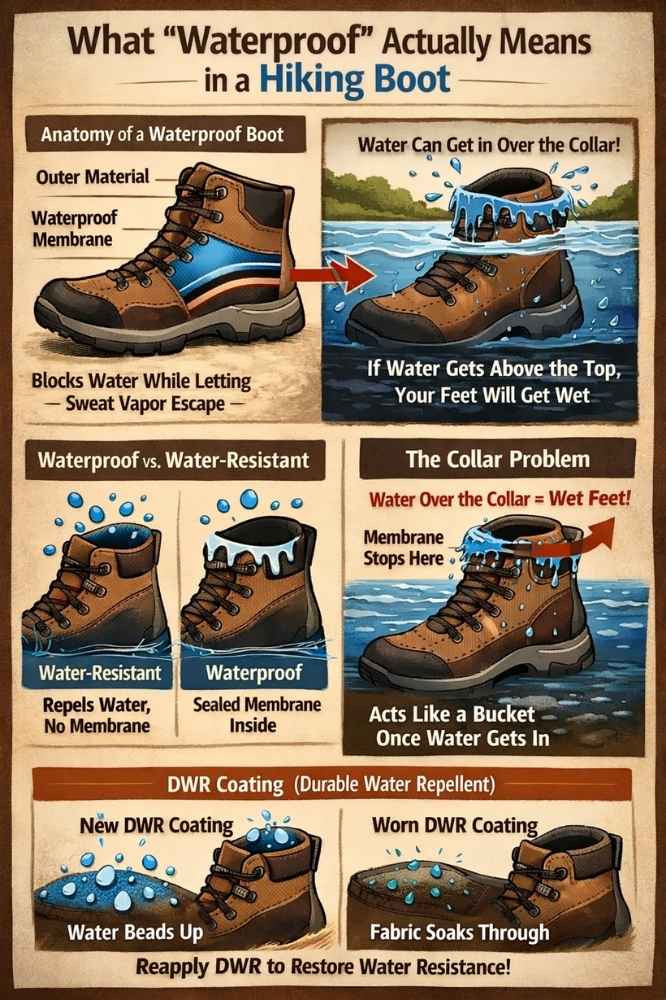
What “Waterproof” Actually Means in a Hiking Boot
A waterproof hiking boot uses a sealed membrane — bonded between the outer fabric and the inner lining — to block water from entering. It keeps feet dry in rain, wet grass, and shallow water, but water can still get in over the collar if the boot is submerged.
Most people picture a waterproof boot as some kind of dry-foot guarantee. It’s not. The membrane is real technology, and it works — but only within limits that the marketing often glosses over.
How a Waterproof Membrane Works
The membrane sits inside the boot like a sock — a thin, porous film bonded between the outer shell and the soft inner lining. The pores in the film are small enough to block liquid water droplets but large enough to let water vapor (sweat) pass out. In theory, it works both ways. In practice, the vapor escape is slower than most people expect, especially when the outside of the boot is wet and the pressure differential drops.
The Collar Problem
This is the one thing waterproof boot marketing almost never mentions. The membrane only covers the upper — it stops at the collar, which is the top edge of the boot. If water rises above that line, it flows straight in. Now you’ve got wet feet and a boot that holds the water like a bucket, because the same membrane blocking water out also slows drainage.
I learned this the hard way on the Wonderland Trail around Mount Rainier. I stepped into what looked like a shallow puddle on a wet trail — it was maybe six inches deep. The water crested over my collar in an instant. My waterproof boots stayed wet for the rest of the day and into the night.
Water-Resistant vs. Waterproof
These two terms get used interchangeably. They should not be. Water-resistant means the outer fabric has a treatment that causes water to bead and roll off — for a while. Waterproof means there’s a membrane inside. You can have both (most Gore-Tex boots do), one, or neither. A water-resistant boot with no membrane will wet out and soak through in a hard rain. A waterproof boot with a worn DWR coating will look soaked on the outside, but the membrane is still doing its job inside.
DWR Coatings and Their Role
DWR stands for Durable Water Repellent. It’s a treatment applied to the outer fabric of the boot — the part you see. When it’s fresh, water beads up and rolls off. When it wears down (and it always does), the outer fabric gets wet and heavy. The membrane underneath still blocks water from reaching your foot, but the outer material soaks up moisture and the boot feels waterlogged. Re-treating your boots with a spray-on DWR restores that bead-and-roll performance. I do it every few months on my wet-weather pair.
The Real Advantages of Waterproof Hiking Boots
Waterproof hiking boots keep feet dry on wet trails, in rain, and through morning dew — which reduces blisters, cold feet, and discomfort on longer hikes in wet conditions.
The case for waterproof boots is real. I’m not here to talk you out of them. On the right terrain, in the right season, they’re one of the best investments you can make for a long day on trail.
Morning Dew and Wet Grass
This might be the most underrated use case for waterproof boots, and nobody talks about it. Rain gets all the attention, but morning dew and wet trailside grass soak non-waterproof shoes in the first half mile. You haven’t even started hiking and your socks are wet. Waterproof boots handle this without a second thought. If you hike in the Pacific Northwest, the Southeast, or anywhere with heavy morning dew from April through October, this alone can justify the membrane.
Cold Weather and Snow Hiking
When temperatures drop, wet feet stop being just uncomfortable — they become a real problem. Cold and wet together drain heat fast. On any hike where snow, slush, or frozen runoff is part of the route, waterproof boots are not optional in my book. I hiked a winter route in Rocky Mountain National Park in February with a non-waterproof pair once. I won’t do that again. The cold that came through wet socks and soaked leather was distracting enough to affect my judgment on trail.
Mud and Muddy Trail Performance
Waterproofing doesn’t keep mud off your boots — nothing does. But it does keep mud from wicking through the outer material into the lining and insole. On muddy trails in Oregon’s coast range, I’ve hiked all day without ever feeling the wet through to my sock. The boot surface was filthy. My feet were dry. That’s a good day.
Blister Prevention in Wet Conditions
Blisters need two things: friction and moisture. Wet skin is soft skin, and soft skin tears faster than dry skin. Waterproof boots keep feet dry longer, which means the friction threshold stays higher. On a long day or a multi-day trip, that difference shows up as intact skin at the end of day three instead of hot spots by mile eight.
Boot Durability in Wet Environments
Waterproof membranes also protect the inner materials of the boot from constant moisture exposure. Foam midsoles, sock liners, and bonded seams all degrade faster when soaked repeatedly. A waterproof boot used in wet conditions often holds up longer internally than a non-waterproof boot getting the same abuse.
I did a three-day loop in the Olympic Peninsula — a wet route even by Olympic standards — with a waterproof boot. It rained every hour of every day. My feet were dry the whole time. That trip sold me on waterproof boots for multi-day wet-climate hiking more than any other experience I’ve had.
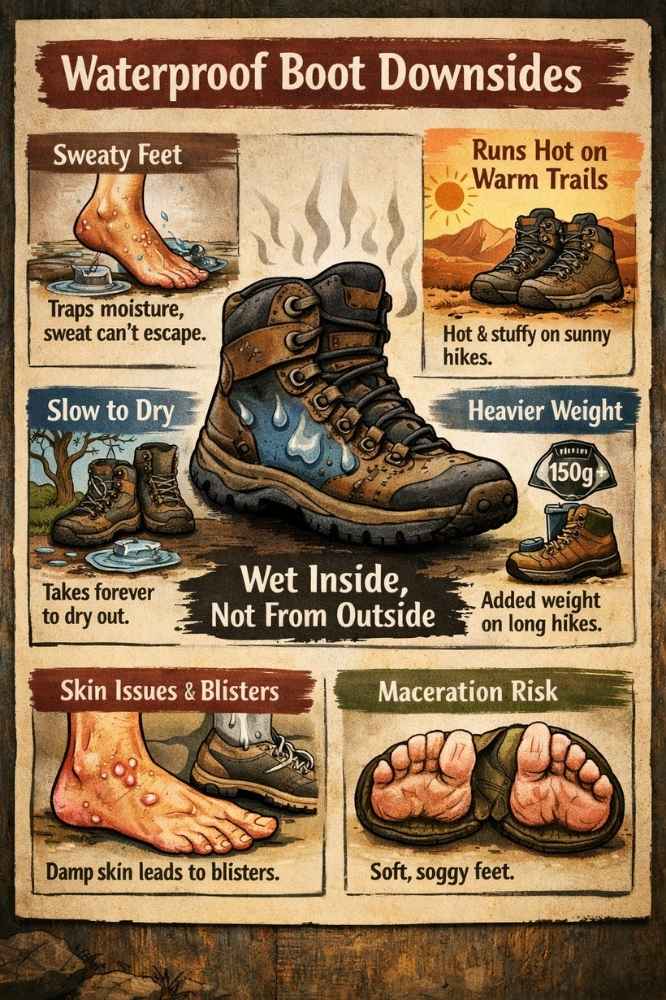
The Downsides Nobody Talks About
Waterproof hiking boots trap internal moisture — sweat can’t escape through the membrane fast enough. On warm or dry trails, this leads to wet feet from the inside, not the outside.
This is the conversation most gear sites skip because it complicates the sell. But after ten years and hundreds of miles in both types, I can tell you: the downsides are real, and they matter on the wrong terrain.
Sweat Accumulation and the Breathability Trade-Off
The membrane that blocks water in also slows vapor out. On a cold, rainy day, that trade-off works in your favor — you produce less sweat, and the small amount of vapor that escapes through the membrane is enough to keep up. On a warm day, you sweat faster than any membrane can clear, and moisture builds up inside. It has nowhere to go. Your feet get wet — not from the trail, from you.
Foot Temperature on Warm Trails
Waterproof boots run hot. The membrane adds an extra layer that traps heat along with moisture. On a summer day hike in New Mexico’s Valles Caldera or on exposed trails in Utah’s canyon country, that extra warmth is the last thing you need. I’ve seen hikers take off their waterproof boots at trailhead and wring out their socks on a day with no rain in sight. That’s not a trail problem — that’s a boot choice problem.
Drying Time After Submersion
Here’s the cruel irony: once water gets in over the collar of a waterproof boot, it dries slower than a non-waterproof boot. The same membrane that keeps water out also keeps it in. A mesh non-waterproof trail runner drains fast and dries in an hour or two of hiking. A waterproof boot with water trapped inside can stay wet for the rest of a trip. I’ve camped with wet waterproof boots on cold nights and woken up to boots that were still damp — not ideal.
Weight vs. Lightweight Hiking Boots
Waterproof construction adds weight. The membrane itself isn’t heavy, but the thicker materials used in waterproof boots generally are. Over a 15-mile day, that extra weight accumulates. It’s not dramatic — we’re often talking 50 to 150 grams per boot — but over weeks of backpacking it adds up in how your legs feel by the end of each day.
The Clamminess Problem
Prolonged moisture inside a boot softens and breaks down skin over time. Hikers call it maceration — a waterlogged softening of skin that makes it more vulnerable to blisters and hot spots. It’s the same thing that happens when you wear wet socks too long. Waterproof boots on warm trails can create this condition faster than non-waterproof boots, because the moisture has nowhere to go. On a July desert hike in red rock country outside Moab, I wore my waterproof trail runners for a full day. By mile six, my feet were soaked — not from the trail, but from my own sweat with nowhere to go. I stopped, peeled off my socks, and let my feet air out for twenty minutes. Lesson learned. Now I carry non-waterproof shoes for dry-season desert trips.
When Waterproof Hiking Boots Make Total Sense
Waterproof hiking boots are worth it when you’re hiking in consistent rain, crossing streams regularly, hiking in snow, or trekking through wet brush — especially on trips where you can’t change socks or dry out overnight.
The conditions below are the ones where I always reach for waterproof boots without thinking twice. If your hike fits any of these, the membrane earns its keep.
Multi-Day Backpacking in Wet Climates
When you can’t dry out between days, wet feet compound. Day one is uncomfortable. Day two is painful. Day three is blisters and raw skin. On any multi-day route in the Pacific Northwest, Northern Rockies, or Appalachians in shoulder season, I pack waterproof boots. The Olympic Coast, the Hoh Rain Forest, the Enchantments in early season — these are not places to gamble on staying dry with mesh uppers.
Winter and Cold-Weather Hiking
Snow, slush, and frozen runoff all find their way inside non-waterproof footwear fast. Cold air also reduces how much you sweat, which tips the breathability trade-off back toward waterproof. In winter, the downsides are smaller and the upsides are bigger. I wear waterproof boots any time temperatures are consistently below 45°F on trail.
Trail Conditions with Standing Water or Stream Crossings
Some routes are defined by water crossings. The Cascades are full of them — especially in June when snowmelt runs hard. On a route I did in the Stuart Range in Washington, I counted nine stream crossings in a single day. Not all of them were shallow. Waterproof boots kept me comfortable through crossings that would have left me hiking in soaked socks for miles. With gaiters added over the collar, waterproof boots handle most crossings that don’t go above the knee.
Cold-Rain Shoulder Season Hikes
Spring and fall have a specific danger window: rain that’s cold enough to chill wet feet quickly, but not cold enough to show up on the forecast as snow. You’re sweating less than in summer, so the breathability trade-off is smaller. You’re in cold rain for hours. This is exactly where waterproof boots perform best. The Cascades in April, the Blue Ridge in November, the Olympics in October — I won’t hike those without waterproof boots.
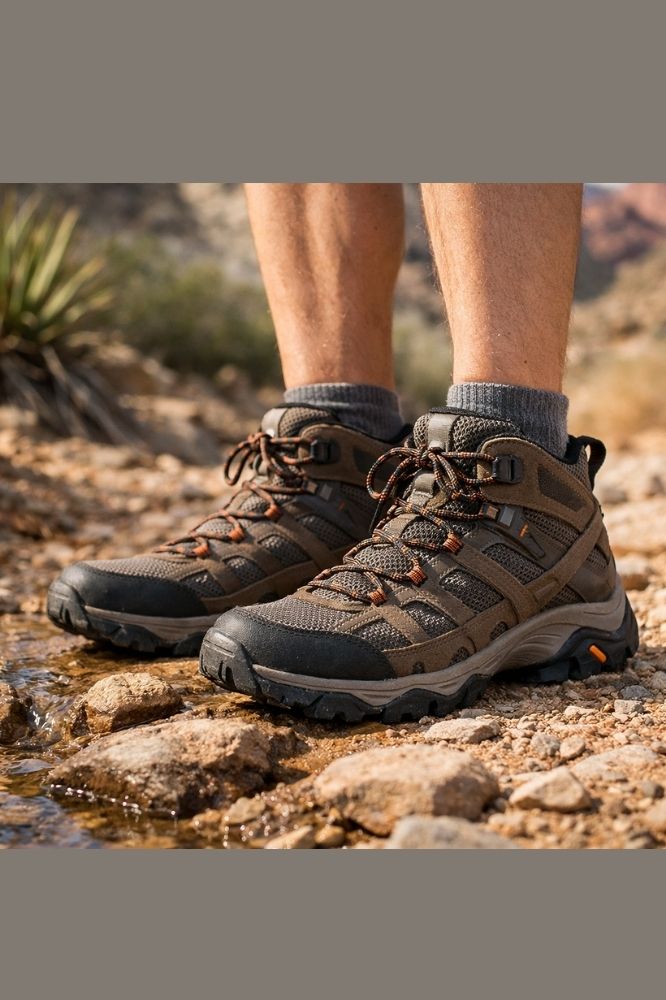
When Non-Waterproof Boots Are the Smarter Pick
Non-waterproof hiking boots perform better in hot, dry conditions — they breathe more, dry faster if wet, and keep feet cooler. For trail runners and warm-weather day hikes, skipping the membrane often means more comfort.
There are conditions where non-waterproof is not just acceptable — it’s the right call. These are the hikes where the membrane works against you.
Hot Weather and Dry Trail Hiking
On sun-baked terrain in summer, your feet are going to get wet one way or another. The question is whether they get wet from sweat or from the trail. In hot weather on dry trails, non-waterproof boots keep feet cooler, let vapor escape faster, and make a long day much more comfortable. I switched to non-waterproof trail shoes for all my summer day hikes in the Sierra Nevada years ago and never looked back for that type of hiking.
Fast-Drying Shoes and Wet Crossings in Summer
In summer, water crossings are often ankle-deep and warm. You’re going to get wet. A non-waterproof shoe that drains fast and dries in an hour is a much better tool than a waterproof boot that holds the water in. Mesh uppers let water in and out. After a creek crossing, you’re back to dry feet in 45 minutes of walking. After the same crossing in waterproof boots, you’re hiking in a boot full of water that won’t clear until you take them off and dump them.
Trail Running and Lightweight Fastpacking
At faster paces, heat output goes up and breathability matters even more. Most trail runners skip waterproof membranes entirely for this reason. If you’re moving fast and light through terrain that doesn’t involve sustained rain or cold, a non-waterproof trail runner is almost always the right choice.
Desert and Southwest-Style Terrain
In the desert Southwest — think Zion, the Grand Canyon, Canyonlands — rain is rare, and when it does fall it’s short and the trail dries fast. Waterproofing adds heat and weight on terrain where you almost never need it. A few times a year I’ll catch a desert thunderstorm, but I’m dry again in thirty minutes anyway. I bring non-waterproof boots to the desert every time.
Day Hikes with Predictable Conditions
If you check the forecast, know the trail, and see clear skies for the next twelve hours, waterproofing is extra weight and extra heat for no benefit. Day hiking on known trails in summer gives you enough information to make a smart call. I check conditions the night before and choose my boots accordingly. It takes ten seconds and saves hours of sweaty feet.
I did a dry-season trip through the canyon country near Escalante, Utah in September. I brought my waterproof boots out of habit and switched to my non-waterproof trail runners after day one. The difference in foot comfort was immediate. I didn’t see a drop of rain the whole week.
Gore-Tex vs Other Waterproof Membranes — Does the Brand Matter?
Gore-Tex is the most recognized waterproof membrane in hiking boots, but other membranes — like eVent, OutDry, and brand-specific options — offer comparable performance. The membrane brand matters less than how well it’s integrated and sealed at the seams.
Gore-Tex is everywhere. It’s on hang tags, box graphics, and marketing pages. But does the name on the label actually make a boot better? Mostly, no.
How Gore-Tex Actually Works vs. the Marketing
Gore-Tex is an expanded polytetrafluoroethylene (ePTFE) film with roughly nine billion microscopic pores per square inch. The pores are large enough for water vapor to pass through but too small for liquid water droplets. The brand licenses its technology to boot manufacturers and requires specific construction standards — which is part of why the name has carried real credibility over the decades. The technology is real. So is the licensing premium.
eVent, OutDry, and Brand-Specific Membranes
eVent uses a similar ePTFE base but claims better direct vapor venting because the membrane isn’t laminated with a protective inner scrim. OutDry, used in Columbia footwear, bonds the membrane directly to the outer fabric instead of floating it inside — which can reduce water absorption in the outer layer. Several brands — Merrell, Salomon, Keen — have their own proprietary membranes that perform well in testing. I’ve worn both Gore-Tex and non-Gore-Tex waterproof boots on the same rain-soaked routes. The performance gap is smaller than the price gap.
Seam Sealing — Where Most Waterproof Boots Actually Fail
The membrane is only as good as the seams around it. If the stitching isn’t properly sealed, water wicks through the needle holes and bypasses the membrane entirely. Budget waterproof boots often use spot-seam sealing only on the most critical seams. Higher-end boots use fully taped seams throughout. When waterproof boots fail early, seam construction is usually the reason — not the membrane itself. Check the seam construction specification, not just the membrane brand name.
How Long Waterproof Membranes Last
A well-made membrane can last the life of the boot — but the seals, the DWR coating, and the outer materials usually degrade first. Most manufacturers suggest you’ll see performance drop between 500 and 1,000 miles depending on conditions and care. The outer fabric DWR needs reapplication every few months with hard use. The internal membrane is harder to test at home, but if your boots feel wet inside and you haven’t done a collar-depth crossing, the seams are likely the problem.
I tested a boot with a brand-specific non-Gore-Tex membrane alongside my GTX boots on a wet stretch of the Appalachian Trail in Georgia in March. Both kept feet dry through a full day of rain and mud. The non-GTX boot was $60 cheaper. I couldn’t identify a performance difference in conditions.
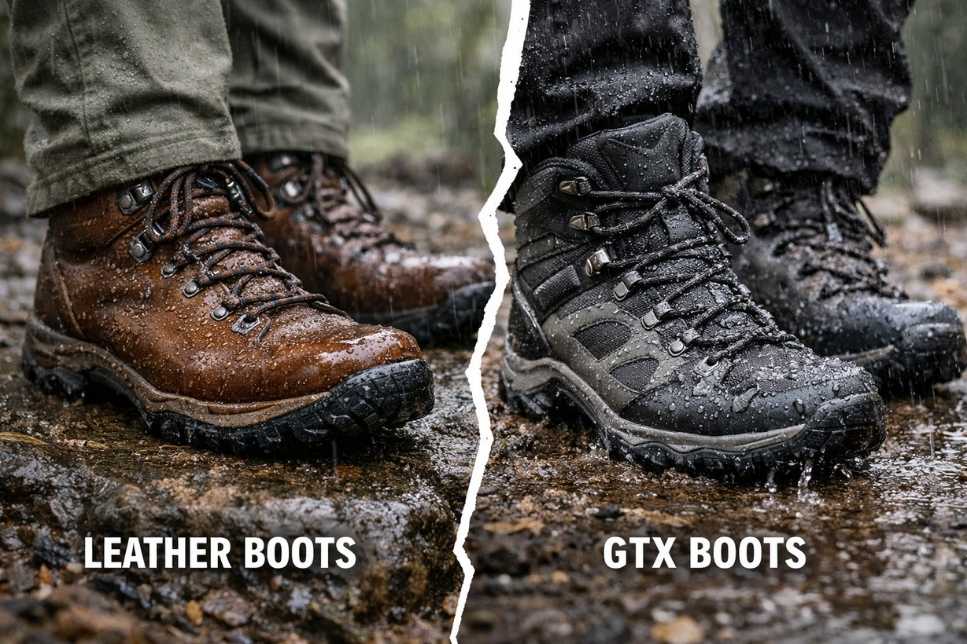
Leather Hiking Boots and Waterproofing — A Special Case
Full-grain leather hiking boots offer natural water resistance that improves with conditioning. They don’t use a synthetic membrane but can shed water effectively for hours — and they’re more repairable and longer-lasting than most synthetic waterproof boots.
Leather is the original waterproof boot technology — and for good reason. Properly conditioned full-grain leather performs differently than anything with a synthetic membrane, and it has real advantages most hikers overlook.
How Leather Naturally Resists Water
Full-grain leather has a tight grain structure that slows water penetration. It’s not waterproof in the same way a membrane is — water will eventually work through it, especially at seams. But with regular conditioning, the oils in the leather fill that grain structure and maintain real water resistance. A well-conditioned full-grain leather boot can shed rain for several hours before moisture starts to migrate through.
Leather vs GTX Membrane Performance in Rain
For the first two to three hours of rain, a well-conditioned leather boot performs as well as or better than a synthetic waterproof boot. After that, moisture starts to move through — especially at the seams. A Gore-Tex boot with sealed seams holds longer in sustained downpour. But leather boots also dry faster than wet synthetic uppers, and they don’t trap internal moisture the same way a membrane does. The trade-offs are different, not one-sided.
Boot Conditioning as Ongoing Waterproofing Maintenance
Leather waterproofing is maintenance-based, not set-and-forget. I use a wax-based conditioner — beeswax products or purpose-made leather boot wax — applied to clean, slightly warm leather every few months with hard use. It takes ten minutes and noticeably improves how water beads off the surface. Skip it for a season and you’ll feel the difference in the first rain. The upside is that you can restore the performance repeatedly, for years.
Why Leather Boots Last Longer Even in Hard Conditions
A quality full-grain leather boot can last ten to fifteen years with care. Synthetic waterproof uppers delaminate, the membranes degrade, and the fabric wears through. Leather can be resoled, reconditioned, and repaired. The economics change when you calculate cost per mile over the life of the boot. I’ve had resoling done on a pair of leather mountaineering boots that are now in their seventh year. They still shed water.
My current everyday leather boots have been on trail in the Cascades, the Olympics, the Appalachians, and the Rockies. I’ve conditioned them probably forty times. They still bead water on wet trails. At seven years old, they have more life left than three pairs of synthetic boots I’ve owned and replaced in the same span.
Frequently Asked Questions About Waterproof Hiking Boots
Are waterproof hiking boots actually waterproof?
Yes — up to a point. The membrane blocks water from rain, wet grass, and shallow crossings. But if water rises over the collar of the boot, it flows straight in, and the membrane holds it there. No waterproof boot fixes the collar problem. They work well within their limits, but those limits are real.
Do waterproof hiking boots make your feet sweat more?
Yes, in warm conditions. The membrane slows vapor escape along with blocking water in. When you sweat faster than the membrane can clear, moisture builds inside. On cool or wet days, this trade-off is manageable. On hot, dry days, your feet can get just as wet from sweat as they would from the trail — without the membrane.
Should I get waterproof or non-waterproof hiking boots?
It depends on your conditions. Wet climate, cold weather, multi-day trips, or regular stream crossings — go waterproof. Hot weather, dry terrain, summer day hikes, or desert routes — go non-waterproof and get the breathability. Many hikers own both and pick based on the forecast and terrain type for each trip.
How long do waterproof hiking boots stay waterproof?
Expect real performance for 500 to 1,000 miles depending on care and conditions. The outer DWR coating wears faster and needs reapplication every few months with hard use. The internal membrane lasts longer but degrades over time. Seam sealing is usually the first thing to fail. Re-treat the outer fabric regularly and check seams if you notice early wet-through.
Can you make regular hiking boots waterproof?
Aftermarket treatments help, but they’re not the same as a built-in membrane. A spray-on DWR treatment can restore water beading on the outer fabric of any boot. A seam sealer can reduce wick-through at stitching. But there is no aftermarket product that performs like an internal waterproof membrane. You’re adding surface resistance, not interior protection.
Are Gore-Tex hiking boots worth the extra money?
For most hikers, the Gore-Tex premium is not fully justified by performance alone. Other membranes perform comparably in real trail conditions. Where Gore-Tex adds value is in consistent quality standards across brands and a strong warranty track record. If you’re choosing between a boot with Gore-Tex and one with a comparable non-Gore-Tex membrane at the same price, buy on fit and construction quality — not the name on the label.
What hiking boots are best for hiking in rain?
Look for boots with a full internal waterproof membrane, fully taped seams (not just spot-sealed), a higher collar for protection from light crossings, and a DWR-treated outer fabric. Fit matters more than brand. A poorly fitted waterproof boot will fail faster at the collar from flex stress than a well-fitted boot with a lesser membrane.
Do waterproof hiking boots work for creek crossings?
For ankle-deep or shallower crossings, yes — waterproof boots with gaiters over the collar can keep feet dry. For crossings deeper than the collar height, no boot keeps water out unless you’re in hip waders. For regular crossings on a route, consider the depth before committing to waterproof boots as your crossing strategy.
My Honest Take — Are Waterproof Hiking Boots Worth It?
The answer is conditional, and anyone who tells you otherwise is selling something.
Waterproof boots are worth every dollar on wet, cold, multi-day terrain. On a three-day Olympic Peninsula loop in October rain, or a winter route in the Rockies, or a shoulder-season creek-crossing day in the Cascades — they’re the right tool and the difference is measurable. Dry feet on day three of a wet backpacking trip is not a luxury. It’s how you avoid blisters, stay warm, and keep moving.
On warm, dry trails, they often work against you. A hot July day hike in the desert or a clear-sky summer trail in the Sierra doesn’t need a membrane. It needs airflow. The sweat your waterproof boots trap on a dry trail creates more problems than any moisture you’d pick up from the ground.
My personal rule of thumb is simple. I ask two questions before I pack boots for any trip: What’s the temperature going to be, and will I encounter standing water or sustained rain? If the answer to both is “cold and wet,” I grab my waterproof pair. If the answer is “warm and probably dry,” I grab my non-waterproof trail runners. If it’s mixed — cool with possible afternoon showers — I usually go waterproof and accept the slight breathability trade-off for the insurance.
I own three pairs of hiking footwear right now: a waterproof mid-height boot for wet season hiking, a non-waterproof trail runner for warm and dry conditions, and a full-grain leather boot for longer trips where durability and repairability matter more than weight. None of them is the right answer for every hike. All of them are the right answer for specific ones.
If you’re still sorting out which type fits your trails best, I’d love to hear about your terrain and conditions in the comments. Drop where you hike most and I’ll tell you what I’d reach for.
And if you’re putting together a full gear kit for wet-weather hiking, check out my post on [hiking rain gear for the Pacific Northwest] — it covers everything from shell layers to gaiters and how I layer for all-day rain.
Read More:
→ Best waterproof socks for hiking
→ Hiking in the rain tips
→ Best hiking boots for beginners

Oscar is a passionate hiker and outdoor enthusiast who has explored trails across mountains, forests, and national parks. He created Oscar Hikes to share honest, beginner-friendly advice on hiking gear, trail safety, and outdoor preparation — so every first-timer can hit the trail with confidence. When he’s not hiking, he’s testing gear and writing guides to make your next adventure easier.
9 thoughts on “Are Waterproof Hiking Boots Worth It? Here’s What 10 Years on Trail Taught Me”