
Hi, I’m Oscar. If you just bought a great new pair of trail shoes, you might be wondering, are hiking boots good for walking? It is a fair question. Maybe you want to break them in around the neighborhood. Maybe you are taking a trip that mixes city streets with dirt paths. Or maybe you just love the ankle support and want to wear them everywhere.
Here’s the thing. Hiking boots are built for rugged outdoor safety. They protect your feet from sharp rocks, mud, and uneven roots. But sidewalks and paved streets are a whole different world. Wearing heavy trail gear on flat concrete can sometimes lead to sore feet, tired legs, or worn-out rubber.
In this guide, I will help you figure out when to lace up your boots for a walk and when to leave them in the closet. We will look at how they feel on pavement, how to break them in safely, and what signs mean you should switch to a regular walking shoe. Let’s dive in.
Quick Answer
Yes, hiking boots are good for walking, but mostly on soft surfaces like dirt, gravel, or grass. If you are walking on paved city sidewalks or concrete, hiking boots can feel heavy and stiff. The tough rubber soles are made to grip rocks, not flat streets, which can make your feet tired on a long neighborhood walk. However, wearing them for short walks is a great way to break them in before a big hike. For everyday walking on pavement, standard walking or running shoes are usually a better and more comfortable choice.
What Hikers Should Know About Wearing Boots for Walking
To understand if you should walk in your hiking boots, you need to know how they are built. Hiking boots are designed differently than your everyday sneakers. They are built to keep you safe and stable on wild, unpredictable trails.
First, let’s talk about the soles. The bottom of a hiking boot has thick rubber bumps called lugs. These lugs dig into mud, snow, and loose dirt to stop you from slipping. When you walk on a hard, flat sidewalk, those lugs do not have anything to grab. This can actually make the boots feel slippery or clunky on smooth, wet concrete.
Next is the stiffness. Inside a hiking boot, there is usually a stiff piece of plastic or metal called a shank. This stops the boot from bending too much when you step on a sharp rock. The American Hiking Society notes that this stiffness helps prevent foot fatigue on rugged terrain. But on a flat street, you want your foot to roll naturally from heel to toe. A stiff hiking boot stops this natural rolling motion, which can make your legs work harder.
Finally, hiking boots are heavier. Even modern, lightweight boots weigh more than standard running shoes. Lifting that extra weight thousands of times on a neighborhood walk takes extra energy. It might not seem like much at first, but after a few miles, you will definitely feel it in your knees and hips.
- Traction: Boots have deep lugs for dirt, while walking shoes have flat treads for smooth streets.
- Stiffness: Boots use stiff shanks for rock protection, while walking shoes bend easily with your foot.
- Weight: Boots use thick leather and heavy rubber, making them much heavier than mesh walking shoes.
- Ankle Support: Boots come up high to stop ankle rolls on uneven ground, which is often unneeded on flat sidewalks.
Signs You Should Adjust Your Hiking Plan, Gear, or Trail Choice
If you decide to wear your hiking boots for a walk, you need to listen to your body. Sometimes your feet will tell you right away that it is a bad idea. Other times, you might not notice until the next day. Knowing when to swap your boots for regular shoes can save you from blisters and pain.
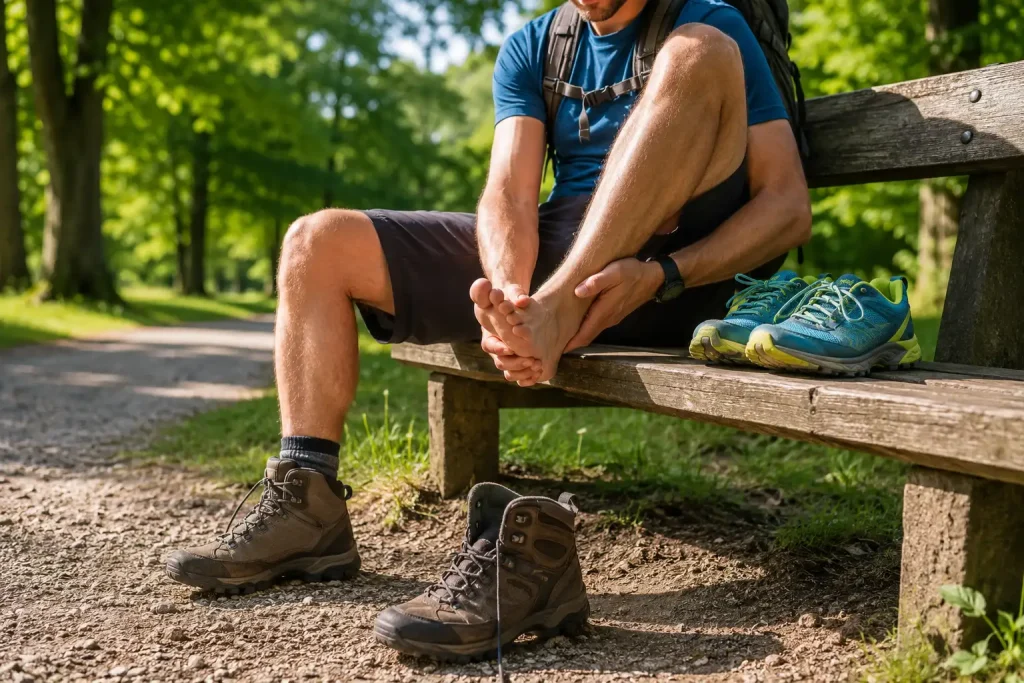
The most common sign that you need to change your shoes is feeling a “hot spot.” A hot spot is a warm, rubbing feeling on your heel or toes. If you ignore it, it will turn into a painful blister. Because hiking boots are stiff, they do not stretch and forgive like soft sneakers do. If you feel a hot spot while walking around town, head home and change your shoes.
Another sign is knee or lower back pain. Walking on concrete in stiff boots sends more shock up your legs because the soles do not cushion the impact as well as running shoes do. If your joints ache after a short walk, your boots are likely too stiff for that surface.
Finally, look at the bottom of your boots. If the deep rubber lugs are wearing down quickly and becoming flat, you are spending too much time walking on concrete. That soft, grippy rubber is expensive to replace. Save it for the dirt trails where you really need it.
| Type of Footwear | Best Terrain for Walking | Flexibility & Comfort | When to Use |
|---|---|---|---|
| Heavy Hiking Boots | Rocks, deep mud, snow, uneven trails | Very stiff, heavy, takes time to break in | Backpacking, rough terrain, winter walking |
| Hiking Shoes / Trail Runners | Dirt paths, gravel roads, some pavement | Moderate flex, lighter weight, breathable | Day hiking, mixed city/trail travel |
| Standard Walking Shoes | Concrete, asphalt sidewalks, indoor tracks | Very flexible, soft cushion, very light | City walking, neighborhood strolls |
How to Handle Walking in Hiking Boots Step by Step
If you need to walk in your hiking boots—maybe to break them in or because it is the only pair you brought on a trip—you can make it more comfortable. Follow these simple steps to protect your feet and get the most out of your boots.
- Start with short distances. Do not put on brand new boots and go for a five-mile walk on the pavement. Start with a 15-minute walk around your block. Slowly add more time as the boots soften up.
- Wear proper hiking socks. Never wear thin cotton socks with hiking boots. Cotton traps sweat and causes terrible blisters. Wear medium-weight merino wool or synthetic hiking socks to cushion your feet and pull moisture away.
- Adjust your laces for flat ground. When hiking down a steep mountain, you want your laces very tight to stop your toes from hitting the front. For flat walking, loosen the top laces just a little bit. This gives your ankle more room to flex forward naturally.
- Pick softer paths when possible. If you are walking through a local park, walk on the grass or the dirt shoulder instead of the paved path. Your boots will feel much better on the softer ground.
- Check your feet often. Stop and sit down if you feel any pinching, rubbing, or burning. Apply a blister bandage or some athletic tape to the area immediately. Do not try to just push through the pain.
- Clean them after your walk. Sidewalks can have oils and chemicals that break down boot rubber. Wipe them down with a damp cloth when you get home.
Hiking Boots: Built for the Backcountry
Hiking boots are your trusted companions when the path ahead throws rocks, roots, and steep inclines in your way. They’re designed to give you confidence and stability when you’re far from smooth, predictable ground. Their construction prioritizes durability and protection, essential for adventures that can last for hours or even days. Manufacturer specifications for top-tier hiking boots commonly list features focused on rugged performance over everyday comfort.
What Makes a Hiking Boot Tough?
When we look at a hiking boot, several key attributes stand out, clearly differentiating them from lighter footwear. These elements are critical for handling the demands of varied outdoor terrain.
- Aggressive Tread Patterns: The soles often feature deep, widely spaced lugs. This design offers superior grip on loose dirt, mud, and uneven rock surfaces, helping to prevent slips and falls. For example, Vibram soles are known for their durability and multi-directional grip patterns designed for challenging landscapes.
- Stiff Sole Construction: Hiking boot midsoles are typically much stiffer than those in walking shoes. This rigidity provides support on rocky or uneven ground, reducing foot fatigue by distributing pressure more evenly and preventing your foot from bending excessively over obstacles. Some robust hiking boots can achieve a torsional resistance level that requires significant force to twist, a spec rarely found or needed in walking shoes.
- Ankle Support: Many hiking boots extend above the ankle, offering crucial support. This higher cut helps to stabilize the ankle joint, reducing the risk of sprains and rolls when navigating treacherous terrain. The level of support can range from mid-cut to high-cut, with high-cut boots offering maximum stability.
- Mid-cut: Provides good ankle support for moderate trails.
- High-cut: Offers maximum ankle stability, ideal for technical terrain or carrying heavy loads.
- Durable and Protective Materials: Uppers are often made from tough leather, synthetic materials, or a combination, designed to resist abrasion from rocks and brushes. Reinforced toe caps and heel counters add extra protection against impacts, shielding your feet from sharp objects. Many also incorporate waterproof yet breathable membranes, like those compliant with Gore-Tex standards, to keep feet dry from both external moisture and internal sweat.
- Heavier Weight: All these protective and supportive features contribute to a higher overall weight compared to walking shoes. This added weight is a trade-off understood by hikers for the benefits it provides on challenging trails.
Walking Shoes: Designed for the Sidewalk
Walking shoes are crafted with an entirely different purpose in mind: making comfortable, efficient locomotion on hard, flat surfaces. Think of your daily strolls, errands around town, or even spending hours on your feet at a trade show. These shoes prioritize cushioning and flexibility to absorb the impact of constant contact with pavement or indoor flooring. Their design philosophy is all about keeping your feet happy and moving smoothly through repetitive strides.
What Makes a Walking Shoe “Walk-Ready”?
The features of a walking shoe are a direct reflection of their intended use on urban terrains and indoor environments. They focus on comfort and natural foot motion for daily wear.
- Ample Cushioning: The midsole is the star here, packed with foam or gel materials designed to absorb shock with every step. This is especially important on hard surfaces that offer little natural give, reducing stress on your feet, ankles, and knees. Manufacturers often specify the type and density of cushioning material, with many using EVA (ethylene-vinyl acetate) foam for its lightweight, shock-absorbing qualities.
- Flexibility: Unlike the stiff soles of hiking boots, walking shoes are built to bend easily, typically at the ball of the foot. This flexibility allows your foot to move through its natural gait cycle for a more comfortable and energy-efficient stride. When you bend a walking shoe, it should flex relatively easily without excessive resistance, mirroring how your foot naturally articulates.
- Lighter Weight: The materials used are generally lighter than those in hiking boots. Less weight means less effort to lift your feet with each step, contributing to greater comfort over long distances and reducing overall fatigue. A typical adult walking shoe might weigh between 8 to 12 ounces (approx. 225-340 grams) per shoe, significantly less than many hiking boots.
- Breathable Uppers: Uppers are often constructed from mesh or knit fabrics, promoting airflow to keep feet cool and dry, especially during warmer weather or extended wear. This breathability helps prevent overheating and the discomfort associated with sweaty feet.
- Lower Profile: Walking shoes generally have a lower cut, typically below the ankle. This design prioritizes freedom of movement and comfort over the specific ankle support that hiking boots offer.
Key Differences: Hiking Boots vs. Walking Shoes
The fundamental divergence between hiking boots and walking shoes lies in their intended environments and the consequent design priorities. If you were to line them up, a trained footwear specialist could tell them apart instantly by their build and the materials used. These differences are not minor; they are fundamental to each shoe’s performance and comfort.
| Feature | Hiking Boots | Walking Shoes |
|---|---|---|
| Primary Terrain | Uneven trails, rocky ground, mud, variable surfaces | Paved sidewalks, asphalt, indoor floors, hard surfaces |
| Ankle Support | High (mid-cut to high-cut) | Low (low-cut) |
| Sole Stiffness | Stiff, rigid | Flexible, bends at the ball of the foot |
| Tread Pattern | Deep, aggressive lugs for superior grip | Shallower, multi-directional for surface contact |
| Cushioning | Moderate, focused on underfoot protection | High, focused on shock absorption |
| Weight | Heavier (often 1.5 – 3+ lbs per pair) | Lighter (often 1 – 2 lbs per pair) |
| Upper Materials | Durable leather, synthetics, waterproof membranes | Breathable mesh, knits, lightweight synthetics |
| Protection | High (reinforced toe/heel, abrasion resistance) | Moderate (basic toe protection) |
| Intended Use | Hiking, trekking, backpacking | Daily walks, errands, casual wear |
The Great Outdoors: Where Hiking Boots Shine
Hiking boots are your go-to when the trail calls. Their design, with aggressive treads and substantial sole stiffness, provides the necessary grip and support to navigate challenging natural landscapes safely. Manufacturer specifications often detail lug depth and outsole compound hardness to emphasize their off-road capabilities. This ensures your foot is protected from sharp rocks and roots, and your ankle is stabilized on steep or uneven grades where a misstep could lead to a sprain.
The waterproof membranes common in many waterproof hiking boots worth it also keep your feet dry through streams or damp undergrowth, a critical factor for comfort and preventing blisters on longer excursions.
The Urban Jungle: Where Walking Shoes Excel
For the vast majority of daily movement, walking shoes are the superior choice. Their primary advantage is the carefully engineered cushioning designed to absorb the high-impact forces generated when your foot repeatedly strikes hard surfaces like concrete or asphalt. Unlike the rigid support of hiking boots, which can feel jarring on pavement, walking shoes offer a forgiving landing with each stride. This specialized shock absorption is crucial for comfort, reducing strain on your joints over time.
Aggregate user reviews frequently highlight that prolonged wear of hiking boots for daily walking leads to increased foot fatigue and discomfort. A well-designed walking shoe, often incorporating advanced EVA foam midsoles or gel inserts, provides this necessary benefit, allowing for easier and more enjoyable ambles around town or on treadmills.
When Your Walk Might Need Hiking Boots
While not your default choice for strolls on the pavement, there are specific scenarios where strapping on hiking boots for your walk can be a smart move. These situations leverage the unique strengths of hiking boots and can significantly improve your comfort, safety, and overall experience. Think of these as specialized uses that go beyond a typical neighborhood walk.
Handling Rough Terrain and Trails
If your daily “walk” involves more than just paved paths, hiking boots can be incredibly beneficial. This includes dirt trails, gravel paths, grassy fields, or even areas with loose stones and tree roots. The aggressive tread patterns on hiking boots, often featuring deep, widely spaced lugs, provide superior grip on these unpredictable surfaces. This enhanced traction significantly reduces the risk of slipping, especially when ascending or descending inclines.
For instance, a trail running shoe has a different lug pattern optimized for speed on dirt, whereas a robust hiking boot’s tread is designed for maximum stability and grip across a wider range of loose and uneven materials. The stiffer sole also helps prevent your feet from feeling every sharp stone or root beneath the surface, offering a more stable and protected experience. For those who regularly engage in this type of activity, investing in appropriate footwear is key to enjoyable what is hiking experiences.
Common Mistakes to Avoid
Many beginners make a few simple mistakes when they try to use hiking boots for everyday walking. Avoiding these will save your feet and make your gear last longer.
- Walking for hours on concrete: Wearing stiff boots for an all-day city tour will exhaust your legs and wear out your boot tread very fast.
- Wearing them on a treadmill: Treadmills are made for flexible running shoes. The stiff sole of a boot can make you walk awkwardly and might even damage the machine’s belt.
- Ignoring hot spots: Assuming a shoe will just “stretch out” on a walk is a bad idea. Boots take a long time to shape to your foot. Treat hot spots right away.
- Tying them too tight on top: Flat walking requires ankle mobility. Tying the top hooks too tight will bruise your shins.
- Using the wrong socks: Using thin dress socks or everyday cotton socks guarantees foot pain when paired with heavy leather boots.
Practical Tips from Oscar
Over the years, I have made my fair share of footwear mistakes. I once ruined a great pair of boot soles by wearing them as my daily shoes on city concrete for an entire winter. Here are a few practical tips I have learned about walking in hiking boots.
Key Takeaways
- Hiking boots are great for walking on dirt, grass, and uneven trails, but they are generally too stiff and heavy for long walks on paved streets.
- Walking on concrete will wear down the expensive rubber traction on the bottom of your boots very quickly.
- Short walks around your neighborhood are the best way to break in new hiking boots safely.
- Always pair your boots with thick, moisture-wicking wool or synthetic socks to prevent blisters, even on short walks.
- If you are mixing city walking and dirt trails, a lightweight trail running shoe or a flexible hiking shoe is usually a better choice than a heavy boot.
Frequently Asked Questions
Can I wear hiking boots on pavement?
Yes, you can wear hiking boots on pavement, but it is not ideal for long distances. The stiff soles can cause foot fatigue, and the rough concrete will wear down the rubber tread faster than walking on dirt.
Will walking on concrete ruin my hiking boots?
Walking on concrete occasionally will not ruin them immediately. However, doing it often will wear the soft rubber lugs flat, making them slippery and less effective when you actually go hiking on muddy trails.
Are hiking shoes better for walking than boots?
Yes, hiking shoes are usually better for walking than tall boots. They are lighter, more flexible, and allow your foot to roll naturally on flat ground, making them much more comfortable for everyday use.
Do hiking boots help with ankle support on flat ground?
Hiking boots do provide ankle support, but you rarely need that much support on flat, even ground like a sidewalk. Ankle support is mostly needed to prevent rolling an ankle on rocky, uneven trails.
Can I use trail runners for walking instead?
Absolutely. Trail runners are highly cushioned, flexible, and lightweight. Many hikers and outdoor travelers prefer them over boots for walking because they offer trail grip while feeling like a normal running shoe.
Should I buy hiking boots a size bigger for walking?
You should generally buy hiking boots half a size larger than your normal street shoes to give your toes room to swell. This applies whether you are walking in them or hiking on steep trails.
Conclusion
So, are hiking boots good for walking? The short answer is yes, as long as you use them in the right environment. They are fantastic for dirt paths, snowy sidewalks, and short break-in walks around your block. But if you plan to spend hours walking on flat city concrete, do your feet a favor and switch to a lighter, more flexible walking shoe.
The right footwear can make or break your outdoor experience. Always listen to your feet, treat hot spots early, and do not force yourself to wear heavy gear when you do not need it. If you want to learn more about choosing the perfect footwear for your next trip, check out my beginner hiking gear checklist for more tips on finding the perfect balance between comfort and safety.
See you on the trail!
